Survivors Add Their Voices in Sixth Circuit Amicus Brief Challenging Registry Laws
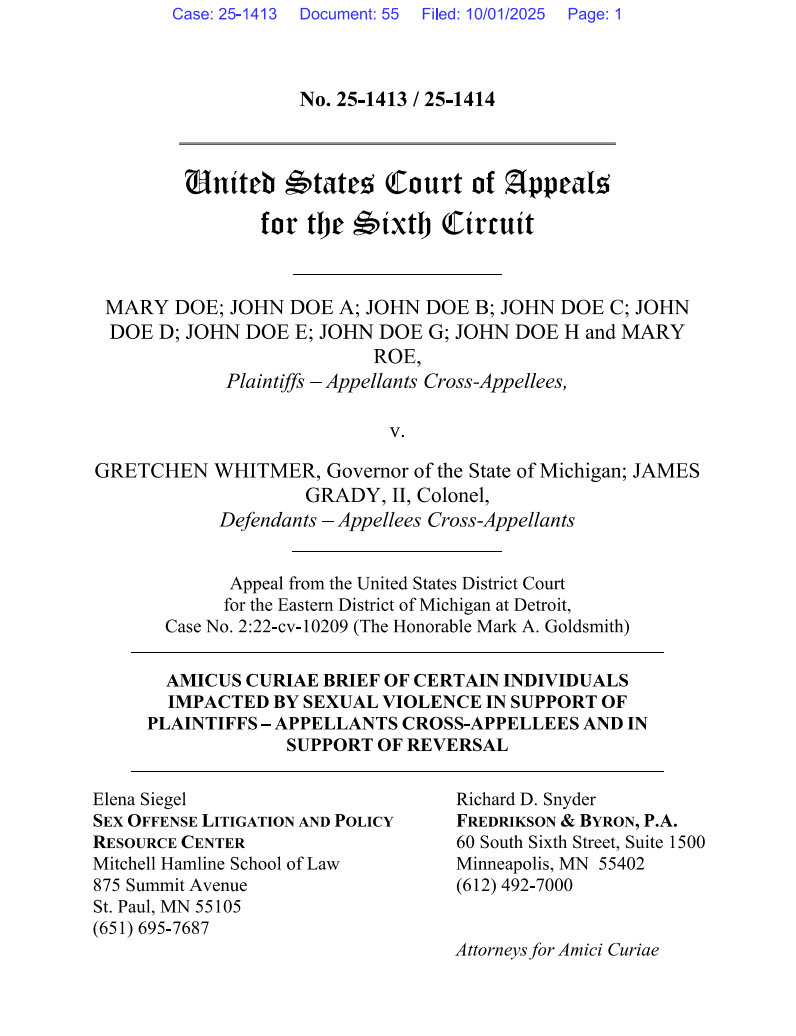
Restorative Action Alliance, Executive Director, Amber Vlangas joined Patty Wetterling and Tashmica Torok in filing an amicus curiae brief with the United States Court of Appeals for the Sixth Circuit in Does III v. Whitmer, a case challenging Michigan’s sex offense registry. The brief was submitted in support of the plaintiffs and urges the court to consider the full range of perspectives from people who have been impacted by sexual violence when evaluating registry policies.
The amicus brief was filed in collaboration with attorneys of the Sex Offense Litigation & Policy Resource Center on behalf of three women whose lives have been deeply impacted by sexual harm. Together, they challenge the widespread assumption that people who have been harmed uniformly support sex offense registries and emphasize that perspectives are diverse, complex, and shaped by lived experience that often differs from common public narratives.
As the amici explain in the brief, registry laws are frequently defended as being “for victims,” yet survivors are not a monolith. The filing notes that the perspectives presented are offered to ensure the court understands that not all survivors support registration and notification laws and that such policies would not have prevented the harms they experienced.
Patty Wetterling, who lost her son Jacob to violence, joined the filing to highlight the importance of prevention-focused approaches to child safety and sexual violence. Tashmica Torok, founder of The Firecracker Foundation, brought her perspective as a suvivor of childhood abuse and a national advocate working to support children who have experienced sexual harm. Amber Vlangas, Executive Director of Restorative Action Alliance, contributed her experience as a survivor and national advocate working to advance prevention, restorative approaches, and evidence-based policy. Together, the amici emphasize that most sexual violence occurs within families and trusted relationships — contexts that registry systems are not designed to address.
Amber’s portion of the brief shares her experience of sexual assault while serving as a young Marine and the long-term impacts of navigating trauma without support, services, or accountability. Through years of advocacy and work with others who have experienced harm, her understanding of safety and prevention evolved.
“Survivors deserve better than promises of safety wrapped in punitive measures,” said Amber Vlangas. “We need approaches that prevent harm, support healing, and promote accountability in ways that actually make communities safer.”
The filing also argues that registry systems can create destabilizing conditions such as isolation, housing instability, and barriers to rehabilitation — factors that ultimately undermine community safety. The amici call for approaches that prioritize prevention, healing, and humanizing accountability.
The Sixth Circuit is now reviewing appeals from both sides following a series of district court rulings that struck down major portions of Michigan’s Sex Offenders Registration Act as unconstitutional. The lower court found that retroactive registration requirements, certain reporting rules, and the registration of people who were not convicted of sexual offenses raised serious constitutional concerns. Portions of the ruling are currently stayed while the appeal moves forward. The outcome of the case could shape the future of registry policies in Michigan and influence ongoing legal challenges across the country.
For more background on the case, visit the ACLU of Michigan’s overview:
https://www.aclumich.org/what-you-need-know-about-does-iii/
Restorative Action Alliance works to end cycles of harm through prevention, restorative practices, education, and advocacy. Participation in this brief reflects the organization’s ongoing commitment to ensuring these voices are represented accurately in courts, policy discussions, and public conversations.